مهندسی تکنولوژی جوشکاری

دانشگاه انقلاب اسلامی پسران شماره یک


 خلاصه سوابق کاری و اجرایی

  • پژوهش و تحقیق پایان نامه کارشناسی در خصوص اثرات مواد مصرفی جوشکاری بر خواص مکانیکی مواد در جوشکاری SAW شرکت لوله و تجهیزات سدید 1395

  • کارشناس کنترل کیفیت و آزمایشگاه رنگ شرکت اتحاد موتور 1399-1400

  • کارشناس انتخاب شناسایی مواد مرکز پژوهش متالورژی رازی 1400-1401

  • کارشناس آزمایشگاه دما بالا و تست های مخرب مرکز پژوهش متالورژی رازی 1400-1401

  • کارشناس واحد دپارتمان مهندسی طراحی تجهیزات دوار ROTARY EQUIPMENTS شرکت 1401@ CARNO  


نویسنده: Ehsan_Nazari.sr ׀ تاریخ: چهارشنبه 25 آبان 1401
ارسال نظر(0)


نویسنده: Ehsan_Nazari.sr ׀ تاریخ: چهارشنبه 25 آبان 1401
ارسال نظر(0)


نویسنده: Ehsan_Nazari.sr ׀ تاریخ: چهارشنبه 28 اسفند 1398
ارسال نظر(0)


نویسنده: Ehsan_Nazari.sr ׀ تاریخ: چهارشنبه 28 اسفند 1398
ارسال نظر(0)


نویسنده: Ehsan_Nazari.sr ׀ تاریخ: چهارشنبه 28 اسفند 1398
ارسال نظر(0)

تصویر را بزرگنمایی نمائید.


نویسنده: Ehsan_Nazari.sr ׀ تاریخ: چهارشنبه 28 اسفند 1398
ارسال نظر(0)


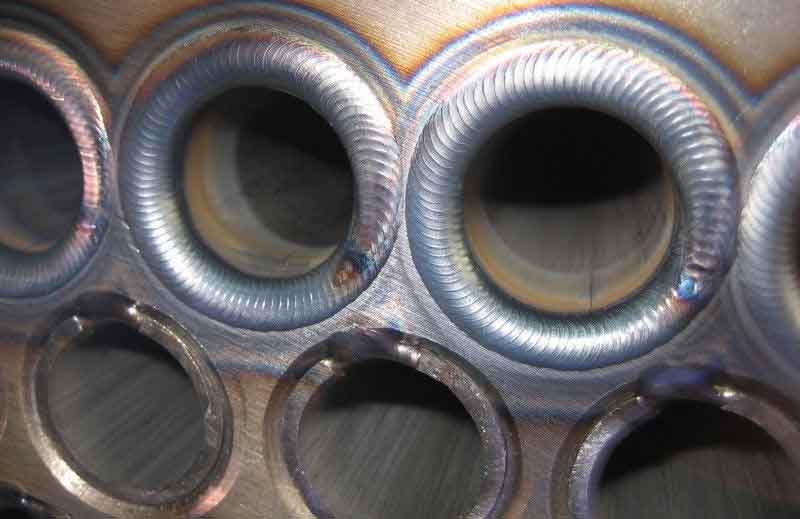
:Orbital Tube-to-Tubesheet Welding   


Industries which apply the orbital TIG Welding Process

  • Aeronautics/Aerospace Industry
  • Food and beverage industries
  • Pharmaceutical and Biotechnology industries
  • Manufacture of Semi-Conductor devices
  • Chemical industries
  • Fossil and Nuclear Power plants

Gases

WELDING GASES

Argon is commonly used as shielding gas in the TIG process. It provides good arc striking characteristics and excellent arc stability even at low amperages, the energy of the arc is confined to a narrow area. Argon is also compatible with all types of base materials.

Shielding gas for standard TIG welding purposes should have a purity of 4.5, i.e. a purity level of 99.995%. Metals which are classified as delicate to weld for example; titanium, tantalum, zirconium and their alloys require a purity of at least 4.8, which means a purity level of 99.998%.

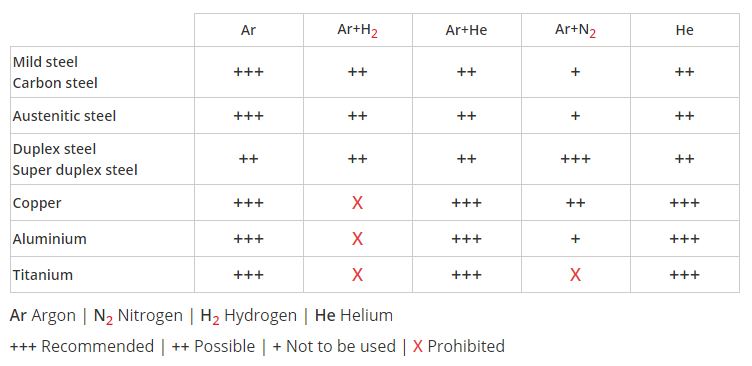
To increase the weld energy, 2% to 5% hydrogen can be added to the argon. As well as a higher energy input of 10% to 20% resulting in a better penetration and faster welding speeds, argon / hydrogen mixtures have reducing properties helping to protect the molten metal against the influence of oxygen from the surrounding atmosphere. However, mild and carbon steels absorb hydrogen with the possible result of porosity and cold cracking, so the use of hydrogen containing gas mixtures is not recommended; for the welding of aluminium and titanium they are strictly forbidden.

The weld energy can also be increased by argon/helium mixtures with helium contents of 20%, 50% or 70% or even pure helium. Helium has no detrimental effects on titanium, so it is used especially to weld the pure metal or titanium containing alloys. Mixtures of argon, helium and nitrogen are used to weld Duplex and Super Duplex steels.

Unlike argon, helium is a good heat conductor. The arc voltage under helium is much higher than under argon, so the energy content of the arc is strongly increased. The arc column is wider and allows deeper penetration. Helium is applied for the welding of metals with high heat conductivity like copper, aluminium and light metal alloys. As helium is a lightweight gas, compared to argon its flow rate for identical gas coverage must be increased two to three times.

.The following table indicates the qualification of different welding gases and mixtures according to the base materials to be joined

Backing Gas

During orbital welding, the inner surface of the tubes must be protected against oxidation. Therefore, the interior of the tube system is purged by backing gas. The purity of the backing gas depends on the required weld quality. Before the weld can be started, a sufficient purge time must elapse, allowing the backing gas to remove the oxygen out of the system.

The remaining oxygen content of the backing gas can be analysed at the outlet; if it has decreased to an acceptable value, the welding operation can begin. Usually in the case of UHP applications (Ultra High Purity) the oxygen level must fall below 10 PPM (Parts per Million), i.e. less than 0.001%.

EXPERT INFORMATION: The supply of ultrapure process gas requires that it passes through the tubes without being contaminated by moisture, oxygen, particles or other contaminants.

During welding, the specified values of flow rate and internal pressure of the backing gas must be respected and kept constant. The internal pressure must be controlled because excessive pressure will produce a root weld with a concave surface at the outside or, even worse, cause a weld bead short circuit.

If tubes with small diameters below 9.52mm (3/8in) are welded, the internal pressure can be used to prevent any excess of convexity or inside diameter reduction.

.EXPERT INFORMATION: A light heat tint, due to remaining oxygen in the backing gas, can be removed by passivation

Source for this page www.polysoude.com


نویسنده: Ehsan_Nazari.sr ׀ تاریخ: چهارشنبه 28 اسفند 1398
ارسال نظر(0)

Properties of Metals

  • hsan.Nazari.sr
  • Last updated: May 11, 2016


The important properties of an engineering material determine the utility of the material which influences quantitatively the response of a given material to imposed stimuli and constraints. The various engineering material properties are given as under.

  1. Physical properties
  2. Chemical properties
  3. Thermal properties
  4. Electrical properties
  5. Magnetic properties
  6. Optical properties and
  7. Mechanical properties

These properties of material are discussed as under

1. Physical Properties:

The important physical properties of the metals are density, color, size and shape (dimensions), specific gravity, porosity, luster etc. Some of them are defined as under.

1.1 Density

Density is defined as mass per unit volume. In metric system its unit is kg/mm3. Because of very less density aluminium and magnesium metals are preferred in manufacturing of aeronautic and transportation applications.

1.2 Color

Color deals with the quality of light reflected from the surface of metal.

1.3 Shape and Size

Dimensions of any metal reflect the size and shape of the material. length, width, height, depth, curvature diameter etc. determines the size. Shape specifies the rectangular, circular, spherical, cuboidal or any other section.

1.4 Specific gravity

Specific gravity of any metal is the ratio of the mass of a given volume of the metal to the mass of the same volume of water at a specified temperature.

1.5 Porosity

A material is called as porous or permeable if it has pores within it.


2. Chemical Properties:

The study of chemical properties of engineering materials is necessary because most of the materials, when they come in contact with other substances with which they can react, suffer from chemical deterioration of the surface of the metal. Some of the chemical properties of the metals are corrosion resistance, chemical composition and acidity or alkalinity. Corrosion is the gradual deterioration of the material by chemical reaction with its environment.


3. Thermal Properties:

The study of thermal properties of materials is essential in order to know the response of metal to thermal changes i.e. lowering or raising of temperature. Different thermal properties are thermal conductivity, thermal expansion, specific heat, melting point, thermal diffusivity.

3.1 Melting point:

melting point is the temperature at which a pure metal or compound changes its state from solid to liquid. Melting point is called the temperature at which the liquid and solid are in equilibrium. It can also be said as the transition point between solid and liquid phases. melting temperature depends on the nature of inter-atomic and intermolecular bonds. Therefore higher melting point is exhibited by those materials possessing stronger bonds. Covalent, ionic. metalic and molecular types of solids have decreasing order of bonding strength and melting point. Melting point of mild steel is 1500°C, of copper is 1080°C and of aluminium is 650C


4. Electrical Properties:

The various electrical properties of materials are conductivity, temperature coefficient of resistance, dielectric strength, resistivity and thermoelectricity.

4.1 Conductiviy

Conductivity is defined as the ability of the material to pass electric current through it easily i.e. the material which is conductive will provide an easy path for the flow of electricity through it.

4.2 Temperature coefficient of resistance

temperature coefficient of resistance is generally termed as to specify the variation of resistivity with temeprature.

4.3 Dielectric strength

Dielectric strength means insulating capacity of material at high voltage. A material having high dielectric strength can withstand for longer time for high voltage across it before it conducts the current through it.

4.4 Resistivity

Resistivity is the property of material by which it resists the flow of electricity through it.

4.5 Thermoelectricity

If two dissimilar metals are joined and then this junction is heated, a small voltage (in the milli-volt range) is produced and this is known as thermoelectric effect. It is the base of the thermocouple. Thermo-couples are prepared using the properties of metals.


5. Magnetic Properties:

Magnetic properties of materials arise from the spin of the electrons and the orbital motion of electrons around the atomic nuclei. In certain atoms, the opposite spins neutralize one another, but when there is an excess of electrons spinning in one direction, magnetic field is produced. Many materials except ferromagnetic material which can form permanent magnet, exhibit magnetic affects only when subjected to an external electro-magnetic field. Magnetic properties of materials specify many aspects of the structure and behavior of the matter. Various magnetic properties of materials are magnetic hysteresis, coercive force and absolute permeability which are defined as under.

5.1 Magnetic hysteresis

Hysteresis is defined as the lagging of magnetization or induction flux density behind the magnetizing force or it is that quality of a magnetic substance due to energy is dissipated in it on reversal of its magnetism. Below Curie temperature, magnetic hysteresis is the rising temperature at which the given material ceases to be ferromagnetic, or the falling temperature at which it becomes magnetic. Almost all magnetic materials exhibit the phenomenon called hysteresis.

5.2 Coercive Force

Coercive force is defined as the magnetizing force which is essential to neutralize completely the magnetism in an electromagnet after the value of the magnetizing force become zero.

5.3 Absolute permeability

Absolute permeability is defined as the ratio of the flux density in a material to the magnetizing force producing that flux density. Paramagnetic materials posses permeability greater than one whereas di-magnetic materials have permeability less than one.


6. Optical Properties:

The main optical parameters f engineering materials are refractive index, absorptivity, absorption co-efficient, reflectivity or transmissivity. Refractive index is an important optical property of metal.

6.1 Refractive index

Refractive index is defined as the ratio of velocity of light in vacuum to the velocity of a material. It can also be termed as the ratio of sine of angle of incidence to the sine of refraction.


Mechanical Properties of Metals


Often materials are subject to an external force when they are used. Mechanical Engineers calculate those forces and material scientists how materials deform or break as a function of force, time, temperature, and other conditions. Materials scientists learn about these mechanical properties by testing materials.

mechanical properties of metals

Some of the important mechanical properties of the metals are Brittleness, Creep, Ductility, Elasticity, Fatigue, Hardness, Malleability, Plasticity, Resilience, Stiffness, Toughness, Yield strength. Above mechanical properties of metals are explained below in brief.

Brittleness:

The tendency of material to fracture or fail upon the application of a relatively small amount of force, impact or shock.

Creep:

When a metal is subjected to a constant force at a high temperature below its yield point, for a prolonged period of time, it undergoes a permanent deformation.

Ductility:

Ductility is the property by which a metal can be drawn into thin wires. It is determined by percentage elongation and percentage reduction in the area of metal.

Elasticity:

Elasticity is the tendency of solid materials to return to their original shape after being deformed.

Fatigue:

Fatigue is the of material weakening or breakdown of equipment subjected to stress, especially a repeated series of stresses.

Hardness:

Hardness is the ability of material to resist permanent change of shape caused by an external force.

Malleability:

Malleability is the property by which a metal can be rolled into thin sheets.

Plasticity:

Plasticity is the property by which a metal retains its deformation permanently, when the external force applied on it is released.

Resilience:

Resilience is the ability of metal to absorb energy and resist soft and impact load.

Stiffness:

When an external force is applied on metal, it develops an internal resistance. The internal resistance developed per unit area is called stress. Stiffness is the ability of metal to resist deformation under stress.

Toughness:

When a huge external force is applied on metal, the metal will experience a fracture. Toughness is the ability of metal to resist fracture.

Yield strength:

The ability of metal to bear gradual progressive force without permanent deformation.


نویسنده: Ehsan_Nazari.sr ׀ تاریخ: سه‌شنبه 22 مرداد 1398
ارسال نظر(0)

Modes of Heat Transfer

  • hsan.Nazari.sr
  • Last updated: Jan 21, 2017


Different modes of heat transfer
Heat is a form of energy which transfers between bodies which are kept under thermal interactions. When a temperature difference occurs between two bodies or a body with its surroundings, heat transfer occurs.
Heat transfer occurs in three modes. Three modes of heat transfer are described below.

  1. Conduction
  2. Convection and
  3. Radiation

Conduction:

In Conduction, heat transfer takes place due to a temperature difference in a body or between bodies in thermal contact, without mixing of mass. The rate of heat transfer through conduction is governed by the Fourier’s law of heat conduction.

Q = -kA(dT/dx)

 Where, ‘Q’ is the heat flow rate by conduction
‘K’ is the thermal conductivity of body material
‘A’ is the cross-sectional area normal to direction of heat flow and
‘dT/dx’ is the temperature gradient of the section.


conduction, convection and radiation are the three modes of Heat transfer

Convection:

In convection, heat is transferred to a moving fluid at the surface over which it flows by combined molecular diffusion and bulk flow. Convection involves conduction and fluid flow. The rate of convective heat transfer is governed by the Newton’s law of cooling.

Q = hA(Ts-T)

 Where ‘Ts‘ is the surface temperature
‘T‘ is the outside temperature
‘h’ is the coefficient of convection.


Radiation:

In radiation, heat is transferred in the form of radiant energy or wave motion from one body to another body. No medium for radiation to occur. The rate of heat radiation that can be emitted by a surface at a thermodynamic temperature is based on Stefan-Boltzmann law.

Q = σ.T4

 Where ‘T’ is the absolute temperature of surface
‘σ’ is the Stefan-Boltzmann constant.


نویسنده: Ehsan_Nazari.sr ׀ تاریخ: سه‌شنبه 22 مرداد 1398
ارسال نظر(0)

Welding Symbols According to IS: 813 – 1991

  • hsan.Nazari.sr
  • Last updated: Nov 24, 2015


Basic Weld Symbols

The basic weld symbols according to IS: 813 – 1961 (reaffirmed 1991) are shown below with sectional representation and symbol in the tabular form for different forms of weld.

Fillet, square butt, single-V butt, double-V butt, single-U butt, double-U butt, single bevel butt, double bevel butt, single bevel butt, double bevel butt, Single-J butt, Bead, Stud, sealing run, spot, seam, mashed seam, plug, backing strip,  stitch, projection, flash, butt resistance or pressure are the different form of welds.
Basic weld symbols
Basic Welding Symbols

Supplementary Weld Symbols:

In addition to the above basic weld symbols, some supplementary symbols according to IS: 813 – 1961 (reaffirmed 1991) are shown below with drawing representation and symbol in the tabular form.

Weld all round, field weld, flush contour, convex contour, concave contour, grinding finish, machining finish and chipping finish are the different particulars of supplementary weld symbols.
Supplementary weld symbols

Elements of a Welding Symbol

A welding symbol consists of the following eight elements:

  1. Reference line,
  2. Arrow,
  3. Basic weld symbols,
  4. Dimensions and other data,
  5. Supplementary symbols,
  6. Finish symbols
  7. Tail, and
  8. Specification, process or other references.

Standard Location of Welding Symbols

According to Indian Standards, IS: 813 – 1961 (Reaffirmed 1991), the elements of a welding symbol shall have standard locations with respect to each other. The arrow points to the location of weld, the basic symbols with dimensions are located on one or both sides of reference line. The specification if any is placed in the tail of arrow. Below image shows the standard locations of welding symbols represented on drawing.

Standard location of welding symbols

Standard location of welding symbols

Some of the examples of desired welding symbols:

  1. Fillet-weld each side of tee-convex contour,
  2. Single V-butt weld machining finish
  3. Double V-butt weld
  4. Plug weld – 30 groove angle-flush contour and
  5. Staggered intermittent fillet welds

The above 5 desired weld symbols drawings are shown below in tabular form.
representation of weld symbols


نویسنده: Ehsan_Nazari.sr ׀ تاریخ: سه‌شنبه 22 مرداد 1398
ارسال نظر(0)

صفحه قبل123...8صفحه بعد

11395 , محفوظ شده توسط احسان نظری سرشکه
مهندسین جوش دانشگاه انقلاب اسلامی 90-95 welding.LoxBlog.Com
💬 نظرات کاربران
💬ثبت نام کاربران
💬ورود کاربران